
Iran is fighting a different war: Older, slower, and in some ways more dangerous. Iran doesn't need to shoot down an F/A-18. It only needs to make the Strait of Hormuz feel dangerous long enough for insurance markets, shipping companies, and oil futures traders to do the rest. Prem Panicker continues his must-read daily blog on the war in the Middle East.

US President Donald Trump indicated the possibility of further military operations against Iran's Kharg Island, a key oil export hub, claiming previous strikes had significantly damaged its infrastructure.

By all available indications, the White House drafted a face-saving note and handed it, ready-made, to Islamabad. Pakistani Prime Minister Shehbaz Sharif was supposed to then post it in the guise of a plea urging Trump to extend the deadline by two weeks 'to allow diplomacy to run its course'. Trump would then graciously accept Pakistan's 'request' and declare a ceasefire. Sharif dutifully posted the message on X. Except that he, or whoever was handling the account, forgot to delete the tell-tale first line visible in the edit history: 'Draft - Pakistan's PM Message on X'. Prem Panicker's must read blog on the Iran War.
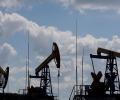
Two days after Russian President Vladimir Putin concluded his visit to India, during which he assured that Moscow would remain a reliable energy supplier, the Kremlin on Monday said that India, as a sovereign nation, is free to buy oil from sources it deems beneficial. It expressed confidence that New Delhi will continue to prioritise its economic interests.

The conflict may disrupt Budget 2026-2027 projections, squeezing revenues and raising subsidies, prompting fiscal adjustments and potential reforms, echoing lessons from the Covid-era shock, points out A K Bhattacharya.

Foreign investors fled Indian equities in 2025 at a scale never seen before, pulling out a record Rs 1.6 lakh crore (USD 18 billion) as volatile currency movements, global trade tensions, especially potential US tariffs, and stretched valuations eroded risk appetite, though flows are expected to turn sustainably positive in 2026.
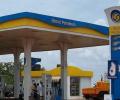
Leading oil companies dedicated the second day of India Energy Week (IEW) 2025 to announcing strategic deals and business agreements across the supply chain - from sourcing more crude oil supply to deploying more domestic ships and building gas distribution capacity.

The intriguing bit is that Trump is likely to attend the talks in Islamabad this weekend -- if he does, it will be the clearest signal yet that the US is ready to exit the war with some sort of win to show, since he cannot afford to go for the talks and return empty-handed, notes Prem Panicker in his must read blog on the Iran War

Foreign brokerages have started to cut their year-end targets for the Nifty 50 index amid the ongoing West Asia conflict.

The rupee witnessed a volatile trading session and settled for the day on a slightly lower note, down 1 paisa at 90.66 against the US dollar on Monday, as traders assessed the details of the India-US interim trade framework.

'India's ties with Israel have to do with defence and general technology.' 'The war changes nothing in what India and Israel hope to get from the relationship.' 'It's not as though India will get significantly more benefits from Iran if India abandons Israel at this time.'
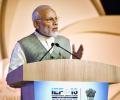
The world, he said, needs to move towards a transparent and flexible market for both oil and gas.

Will rising tensions between US-Israel and Iran threaten crude oil supply through the Strait of Hormuz, putting India's fuel prices, imports, and economic stability at risk?

Tulsi Tanti, the founder chairman and managing director of Suzlon Energy and a renowned expert on renewable energy, died due to cardiac arrest on Saturday evening. Tanti, 64, who was also the chairman of the Indian Wind Turbine Manufacturers Association, was on his way to Pune from Ahmedabad when he suffered a cardiac arrest, a company official said. He is survived by his daughter Nidhi and son Pranav.

Both sides have now revealed a preference for escalation over strategic defeat, and each new provocation narrows the space for the next pause. The Touska seizure, Iran's refusal to negotiate under blockade, Israel's strikes on Iranian oil infrastructure -- all of these add up to an increasingly untenable situation. This makes the wild card -- Trump and his motormouth -- more consequential than ever, notes Prem Panicker in his must read blog on the Iran War.

French automotive component maker Valeo on Wednesday said it will invest over Rs 2,150 crore in India and treble its annual sales in the country to around Rs 7,510 crore by 2028.

In the wake of the FTA between India and the European Union, the United States has described the Europeans as 'very disappointing', saying they were unwilling to join Washington, DC in putting tariffs on New Delhi for its purchases of Russian oil because of this trade deal.
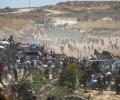
India has called for a ceasefire, release of all hostages, and peaceful resolution of the Israel-Hamas conflict through dialogue and diplomacy. The Centre informed Parliament that India welcomed the agreement on the first phase of the Gaza Peace Plan. The article also covers India's energy sourcing strategy and the release of Indian fishermen by Pakistan.

India's new climate pledge to the UN could be weakened by its growing use of coal, even as the country plans a 2035 roadmap to cut emissions and boost clean energy.

A disruption in the supply of LPG cylinders caused by tensions in the Strait of Hormuz is impacting Indian kitchens, leading to restaurant closures, price hikes and a surge in demand for electric cooktops.
Russian President Vladimir Putin's visit to India this week aims to secure energy supplies, stabilise defence deliveries and ensure bilateral trade continues smoothly despite strong Western sanctions, GTRI said on Tuesday.

'The trade deficit in some sectors is huge and that is an area of opportunity to localise.'

Among Sensex firms, Tech Mahindra, HCL Tech, Eternal, Axis Bank, Maruti, Tata Steel, HDFC Bank and Asian Paints were the gainers. However, Adani Ports, Trent, Tata Motors, Hindustan Unilever and NTPC were among the laggards.
Revenue collection next financial year may be affected, and, along with this, subsidies on food and fertilisers can go up if the war in West Asia drags for long, according to experts.

This was perhaps a missed opportunity for India to spotlight a core domestic challenge: The scale of workforce preparation required for a young, populous, rapidly growing country seeking to reach net zero, points out Radha Roy Biswas.
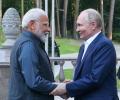
The Indian government is dealing with the matter having in mind the national interests of this country in the first place, he said.

India will now face a lower reciprocal tariff of 10 per cent, down from 25 per cent, after US President Donald Trump announced a new global levy on items imported into America in the wake of the Supreme Court verdict against his sweeping duties on several nations.

Global index provider MSCI has announced the addition of four Indian companies-including Fortis Healthcare and Paytm - to its Global Standard indices. According to Nuvama Alternative & Quantitative Research, each of these companies is expected to see passive inflows exceeding $400 million. Shares of Paytm rose 4.3 per cent on Thursday, while Fortis Healthcare dipped 1.1 per cent.

'In the long run, India's strong growth story and reforms to make assets globally attractive will determine the rupee's resilience.'

Among the Sensex firms, NTPC climbed over 3 per cent emerging as the biggest gainer. Tata Motors, Sun Pharma, Tata Steel, State Bank of India, UltraTech Cement, JSW Steel, Bajaj Finance, Reliance, ICICI Bank and IndusInd Bank were the other major gainers. Power Grid, HCL Technologies, Tech Mahindra, Tata Consultancy Services, Infosys and Titan were among the laggards.

The LPG squeeze on India's restaurant sector is the quotidian face of a deeper crisis.

Sanctioning Russian oil would have led to a sharp surge in oil prices to above $80 per barrel levels, which would impact pump prices in the US ahead of midterm elections next year.

The purge in Washington does not pause the war. Strikes continue, Hormuz remains closed, and Brent crude is still dancing around $109 a barrel. For India, the command chaos in the Pentagon is another layer of uncertainty piled on five weeks of conflict that was already straining every buffer Delhi has.
'The real story of 2025 is that India officially stopped being a 'market of the future' and started acting as the world's primary economic engine.'

'Our diplomacy should have been focused on preventing war and avoiding the inevitable disruptions it would cause, posing a real risk to India's growth story,' asserts former foreign secretary Shyam Saran.

A 500 per cent tariff would effectively shut out India's goods and services exports to the US.

What we are watching is something different: A fog manufactured and maintained by the people who started the war, so that the question of why it was started never has to be answered, observes Prem Panicker in his must read blog on the war in the Middle East.

'We do have some concerns with the timeline being shortened from 18 to 12 months.'

Restoring weighted tax deductions and adopting a petty patents regime can foster firm-level innovative activity critical for competitiveness, points out Nagesh Kumar.

India is on track to exceed the $4 trillion milestone in 2025-26 (FY26), surpassing the $3.9 trillion gross domestic product (GDP) mark recorded at the end of March 2025, Chief Economic Adviser (CEA) V Anantha Nageswaran said on Tuesday.
